Originally posted by qtiger
Well... yes and no. Ceramic coated headers are more heat resistant, and therefore should keep your underhood temps lower.
In addition, high temperatures are good for exhaust gas velocity, which is one of the reasons people are so fond of header wraps, sprays, etc.
BUT most ceramic coated headers are mild steel, which can be prone to cracking, rusting, and other annoyances.
So let me break it down:
Ceramic coating :thumbup:
Mild steel :thumbdown
Stainless steel :thumbup:
Ceramic coated stainless steel :thumbup: :thumbup:
First of all, a street designed 4-1 header should never lose low end power over stock. They may not provide gains anywhere near the magnitude of a 4-2-1 setup on the low end and midrange, but in general the OEM units flow pretty miserably (with the exception of R models) and to lose power an aftermarket header would either have to be A) too large for your setup or B) poorly designed.
Second, where the greatest power gains given by a header are located in the power band depends more on when and how the primaries merge than the basic layout.
For example, on many more expensive headers (such as the Spoon header shown below), you may see a 4-2-1 design, but the two merges are done in close succession just before the catalytic converter, in the style of a 4-1.
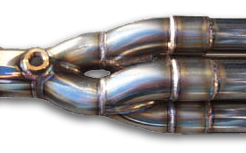
This tri-Y design creates a middle ground between 4-1 and 4-2-1 headers, and with modification of the distances between the merges you can create almost any desired result.
What you were saying was basically correct, but it is a lot more complicated than you may have thought.
It *is* more complicated! ... that's interesting, and thanks for the info. I'm looking for headers now, actually, and this gives me more meat to chew on. Sweet! :thumbup: